
TRANSGRESSIVE EMBEDMENT (The Library as a Turkey That Does Not Give Thanks)
by John Clute

We need to thank any library sufficiently intransigent in 2025 to contain a book. Any library whose physical stock -- whose rows of bound volumes -- can be seen and touched must be thanked. A library whose stock can be touched, where it is understood that a book and its information exist in a state of haptic intercourse, a place where information can be experienced, should be kept safe.
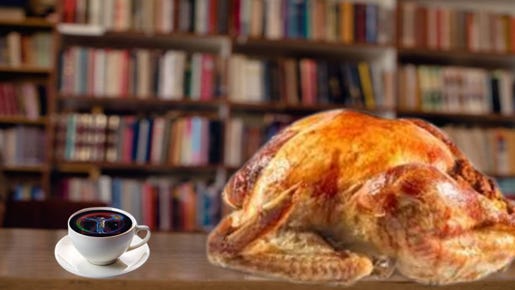
So we’re not here at the moment to thank the kind of institutional “library” after the years of plague when books, once their information “content” was abstracted into digital form, were routinely destroyed; the kind of library whose innards, like frozen elevator music, evoke the terrifying cenotaphic interior spaces Stanley Kubrick created for 2001: A Space Odyssey (1968), in order to demonstrate the denuded torpor Homo sapiens had sunk into by 2001: how desperately we needed help to mature as a species: we know the answer we gave. We can of course thank digital libraries for the abyssally fertile maps of nearly infinitve amounts of data they contain, data doors within data doors like Arabian Nightmares; but we cannot thank their makers for attempting to disable our deep intuition that in the end, after much journeying, maps are less not more. That even the profoundest of Borgesian maps can only describe more fully that which can be described. That when you misdescribe a thing in the world, the skinned torso of the Thing in the World does not become whatever. You do.

It is perhaps easy for a technician to slide into the presumption that only that which can be measured -- which is to say only that which can be transferred -- exists in any meaningful fashion. But this is to imply that every thing in the world is already a copy, and that every digital rendering of a thing in the world is a clone. That when the turkey is entirely sliced into thanks, there is nothing left. Like the tech-bro-curated future in the late instalments of Westworld (2016--): nothing left. Like Sweats-of-Dearth Mall, out there in the unzoned Somme between the ruins of the town and the Interstate, draining the pond and the river and the aquifer to dust: nada.
In what is almost certainly his most famous single essay, “The Work of Art in the Age of Mechanical Reproduction” (1936 Zeitschrift für Sozialforschung; trans Harry Zohn in Illuminations 1969), Walter Benjamin, speaking of the work of art not a book (but hey), introduces a concept which cannot be so much understood as felt: the short passages I quote here from Zohn’s version are slipped into loosely adjacent paragraphs that when put together convey the heart of what I understand him to be saying:
Even the most perfect reproduction of a work of art is lacking in one element: its presence in time and space, its unique existence at the place where it happens to be.
The authenticity of [this unique embodiment of itself] is the essence of all that is transmissible from its beginning, ranging from its substantive duration to its testimony to the history which it has experienced.
That which withers in the age of mechanical reproduction is the aura of the work of art [my italics throughout].
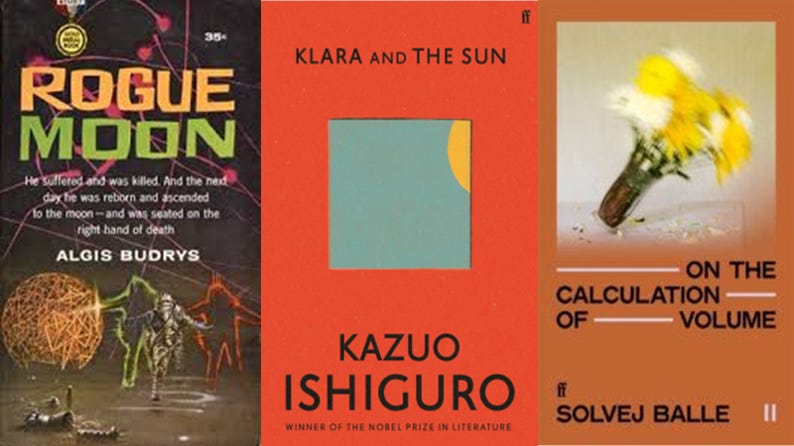
So maybe the aura is what has been lost whenever Gene Wolfe (in particular) introduces a clone, for they all seem ineradicably thinned; and what A J Budrys was getting at in Rogue Moon (1960) as his protagonist goes through the dehumanizing ordeal of matter transmission; and what the android heroine’s disjointed mentation-kit cannot acquire in Kazuo Ishiguro’s Klara and the Sun (2022); and what Solvej Balle’s hallucinatedly moving On the Calculation of Volume (1920- ) (projected to end only after 7 volumes) increasingly invites the reader to aspire to experience: the epiphanic thereness of the world as embedded in one repeated day: a day that cannot be “remembered” from the next day: a day that, the more she lives within it, the more intrinsicately it marries her to the aura of the world.
And maybe it might be fair, though it rather tramples on Benjamin, to think of each individual book in a library as a work of art, as a thing itself from which aura can be stripped. So the library I’ve been helping build in Telluride, Colorado, can be best understood as a kind of time-machine, or generation starship in the mysterium of night: built to last out our age: a transgressive embedment of the real world, which is to say the past, in a century ravenous of the past. But any library must handshake. The Telluride library is the site of an ongoing experiment in synergy: taking an ultimately immeasurable dominion of things in themself -- 14,000 pleromatic first editions, mostly in dust-jacket, with no repetitions: each book having, as per Benjamin, skin in the game of time -- and marrying that array of things themself to immensely powerful protocols of access for digital sorting and research. It is a daunting challenge: to intimately touch the deep dream stories of the real world, and leave not a rack behind. If there are other experiments in this kind of exercise currently active, it would be good to learn of them. It is of course transgressive in 2025 to see the book as the beginning and end of things, and to assert that a multiply interwoven AI banyan of digital descriptors and links must be understood as supportive. But how else can you get the world except by living it?
John Clute has been writing SF and fantasy criticism since the 1960s, much of which has been assembled in several collections, beginning with Strokes (1988); he has been involved in writing encyclopedias since the 1970s. His novel Appleseed (2001) was a New York Times Notable Book in 2002. He is currently working on the fourth edition (online from 2021) of The Encyclopedia of Science Fiction and its affiliated Substack.
SFE links
2001: A Space Odyssey: https://sf-encyclopedia.com/entry/2001_a_space_odyssey
Arabian Nightmare (EoF): https://sf-encyclopedia.com/fe/arabian_nightmare
Solvej Balle: https://sf-encyclopedia.com/entry/balle_solvej
Jorge Luis Borges: https://sf-encyclopedia.com/entry/borges_jorge_luis
A J Budrys: https://sf-encyclopedia.com/entry/budrys_algis
Stanley Kubrick: https://sf-encyclopedia.com/entry/kubrick_stanley
SF Collection in Telluride: hhtps://www.tellurideinstitute.org/clute-sci-fi-library-opens-to-the-public/
Westworld https://sf-encyclopedia.com/entry/westworld_tv
Gene Wolfe: https://sf-encyclopedia.com/entry/wolfe_gene
other links
Walter Benjamin: https://www.hup.harvard.edu/features/walter-benjamin-philosopher-cultural-critic-and-essayist
Work of Art in Age of Reproduction: https://web.mit.edu/allanmc/www/benjamin.pdf
elevator music: https://en.wikipedia.org/wiki/Elevator_music
pleroma: https://www.merriam-webster.com/dictionary/pleroma
Sweats-of-Dearth: https://englishverse.com/poems/the show
Lovely piece.
Lucy and I just spent a couple days in the SF Public Library, one of the most beautiful and reader-oriented libraries I've ever seen. (Not that there were many readers in it, but they were there, I like to ssure myself...) They're not all turkeys! s